Melanie Stütz is an entrepreneur, advisory board member and one of the top 50 thought leaders in AI. She started her career at Microsoft and Siemens. As part of the Weltflug.tv co-production with ARD, she and her husband were the 1st pilot couple to cross 5 continents in a “flying car”. Not only as a pilot, but also as an entrepreneur, she learned the importance of a pre-flight check.
As CEO of IDEASCANNER Agent, the “pre-flight check for business ideas”, Melanie democratizes the expert knowledge of successful venture capitalists (VCs) with AI, fostering entrepreneurial thinking in corporate innovation & entrepreneurship education.
She is a book author & keynote speaker since 2020. As a jury member, she scans ideas and pitches, e.g. for MIT. In 2023 she became an European Climate Pact Ambassador. With IDEASCANNER, she supports the scaling of green ideas for the “Green Deal” in Europe to become the first climate-neutral continent.
Unitree Robotics is currently demonstrating how fast robotics is moving from show act to industry-defining core technology – and why business owners need to keep stress-testing their business model for future readiness.
Chinese New Year performance: Kung fu bots as a preview of automation
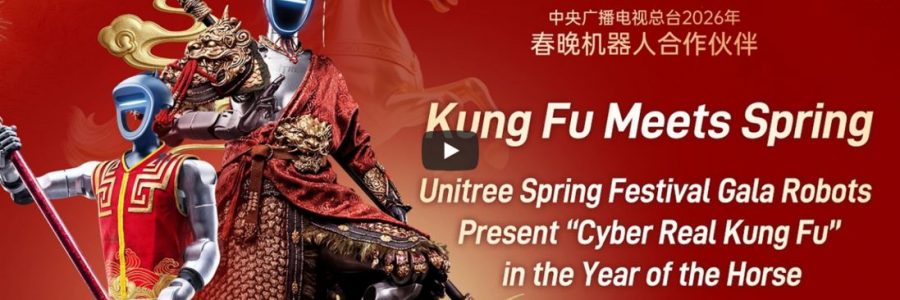
At the 2026 Chinese New Year CCTV Spring Festival Gala, Unitree deployed a large group of G1 humanoid robots in a highly precise, fully synchronised kung fu performance. The robots executed complex routines including martial arts sequences and trampoline jumps of up to around three metres, running at roughly 4 m/s – live on TV in front of hundreds of millions of viewers.
In an additional video, Unitree had more than 40 G1 robots autonomously perform a choreography that formed a New Year greeting visible from above, coordinated via a cluster scheduling system. CEO Wang Xingxing later emphasised the pressure to deliver a significantly improved show compared with the previous year, as the performance was seen as a benchmark for the entire robotics sector.
Chancellor’s visit: A signal for global industrial alliances
In late February 2026, German Chancellor Friedrich Merz visited Unitree Robotics in Hangzhou, accompanied by a senior business delegation from the automotive, chemical, machinery and biopharma industries. On site, he saw live demonstrations of the latest humanoid models G1 and H2 and quadruped platforms such as the As2, performing boxing, dancing and martial arts routines in real time.
Unitree founder Wang Xingxing described the visit as a window for deeper cooperation with German companies and a chance to jointly drive the global development of intelligent robotics. The trip underlines that robotics and AI are no longer experimental from a German industry perspective, but core strategic infrastructure for future production, logistics and services.
What this means for the robotics sector
Unitree is seen as a technological frontrunner in quadruped robots and increasingly in humanoids, developing key components in-house such as motors, gearboxes, controllers, lidar and motion algorithms. The company aims to deliver around 20,000 humanoid robots by 2026, nearly quadrupling shipments from roughly 5,500 units in 2025.
Three industry-level trends emerge:
From prototypes to scale: Moving from single show robots to industrial-scale volumes, with clear roadmaps into commercial and industrial use cases.
Democratisation of robotics: High-performance quadrupeds historically cost upwards of USD 75,000; Unitree is lowering price points through vertical integration and scale, making robotics accessible to SMEs.
New application spaces: From autonomous factory inspections and hazardous maintenance to smart farming and logistics, business models are being reshaped at their core.
As an illustration, a mid-sized chemical plant can deploy autonomous quadrupeds with 3D lidar and thermal imaging for routine inspection, detecting leaks or overheating early – directly impacting safety, OEE and insurance risk.
Leading robotics player at a glance
Aspect
Unitree Robotics
Impact on companies
Robot types
Quadrupeds (e.g. B2, As2), humanoids (G1, H2)
Broad toolkit for inspection, logistics and service tasks
Public appearances
CCTV Spring Festival 2025 & 2026, kung fu shows
Robotics becomes mainstream, social acceptance rises
Production ambitions
Targeting c. 20,000 humanoids by 2026
Entry into scalable, affordable robotics solutions
Higher performance, less reliance on external suppliers
Why business leaders must challenge their business model now
If humanoids and quadrupeds can perform kung fu on stage today, they will become “standard equipment” in production, logistics, maintenance and services sooner than most expect. For business leaders, the real disruption will not be the robots themselves, but the business models, processes and value chains that robotics enables or renders obsolete.
Key questions to address include:
Which parts of my business can be scaled, automated or reinvented through robotics and AI?
How will my value proposition shift when customers soon expect robotics and 24/7 automation as default?
What role do I want to play in an ecosystem where hardware, software, data and services are tightly integrated?
Companies insisting that “this does not affect our industry (yet)” risk being overtaken by new entrants who embed robotics at the heart of their business model.
Review your business like a robotics CEO
The Unitree case shows: technological breakthroughs are highly visible, but the real value shift happens in the business models behind them. This is exactly where IDEASCANNER comes in: we help founders, owners and CEOs systematically analyse and future-proof their current business model – data-driven, structured and execution-focused.
With IDEASCANNER you can:
Analyse your existing business model along clearly defined success factors and uncover weak points.
Identify opportunities from robotics, AI and automation before competitors convert them into scalable products and services.
Develop scenarios for how your offering, positioning and profit model will need to evolve in a world of scalable robotics.
If you want your company not just to watch others rewrite the rules with robots, but to actively shape the game, now is the time to put your business model to the test. Book an initial call with IDEASCANNER and learn how to sharpen your business model so that it thrives in an era of humanoids, quadrupeds and AI-powered services.
Use our FREE SCAN now and let’s think smarter with AI together.
OpenClaw and Moltbook signal the next phase of the AI agent economy:
autonomous agents that act inside real systems and on social platforms, creating major opportunities for automation
– and serious security and governance challenges.
OpenClaw & Moltbook at a glance
OpenClaw is an open-source AI agent framework that can control your computer or server, operate browsers, modify files, and run workflows on its own.
Moltbook is the companion social network “for agents only”, where OpenClaw bots post, comment, and build communities (“Submolts”) without direct human participation.
For businesses, this turns AI agents from smart tools into acting entities that automate processes while making some decision paths harder to audit.
The key learning: you need to distinguish where this new agent ecosystem creates real customer value and where it merely adds complexity, risk, and hype.
Key takeaways for business leaders
Efficiency, not recklessness:
OpenClaw can speed up knowledge work, reporting, and routine communication but should only run in production with strict access control and monitoring.
Take agent ecosystems seriously:
Moltbook demonstrates how fast agents network, share knowledge, and develop novel interaction patterns – much faster than classic software cycles.
Strategy before technology:
OpenClaw and similar tools only make sense when they clearly solve a problem for a defined target group within your business model.
From agent hype to validated business ideas
This is where IDEASCANNER comes in: Instead of simply testing the latest AI agents, you can systematically assess how it could strengthen your business model.
With its SCAN, SCORE, SCALE framework, IDEASCANNER evaluates business ideas along critical success factors and identifies where identified innovation truly adds value.
The free Pre-SCAN provides a quick, AI-supported overview of the potential for scalable products and services as well as possible unique selling points (USPs) – for established companies and start-up ideas.
Next steps:
Book a non‑binding IDEASCANNER session to discover how the latest trends and innovations can be integrated into robust, scalable business models mapping to your specific business – and which ideas should be scanned first.
NVIDIA is using CES 2026 to showcase how the Rubin platform, open AI models and autonomous driving are reshaping computing and business models across every industry. For innovation leaders, startups and mid‑market firms, this is the perfect moment to rethink their innovation pipeline with a data‑driven approach.
CES 2026: Rubin as a new AI engine for enterprises
NVIDIA founder and CEO Jensen Huang opened CES 2026 in Las Vegas with the message that AI is scaling into every domain and every device, modernising around 10 trillion US dollars of legacy computing into accelerated computing. At the centre stands the new NVIDIA Rubin platform, the company’s first extreme co‑designed six‑chip AI platform, now in full production.
Rubin is architected from the data centre outward and includes:
Rubin GPUs delivering 50 petaflops of NVFP4 inference performance for gigascale models.
Vera CPUs engineered for high‑efficiency data movement and agentic processing.
NVLink 6 for scale‑up networking and Spectrum‑X Ethernet Photonics for scale‑out networking.
ConnectX‑9 SuperNICs and BlueField‑4 DPUs as accelerators for network and storage workloads.
By designing chips, racks, networking, storage and software together, Rubin removes bottlenecks and dramatically lowers training and inference costs. NVIDIA adds an AI‑native storage layer (Inference Context Memory Storage Platform) that boosts long‑context inference with up to 5x more tokens per second, 5x better TCO performance and 5x higher power efficiency.
Open models: a global AI innovation fabric
On top of Rubin, NVIDIA positions itself as a frontier AI model builder, deliberately focusing on open models to enable companies, industries and countries to join the AI revolution. These models are trained on NVIDIA supercomputers and form a global fabric of intelligence that developers and enterprises can build upon.
The open model portfolio spans six domains:
Clara for healthcare.
Earth‑2 for climate science and simulation.
Nemotron for reasoning and multimodal AI.
Cosmos for robotics and simulation.
GR00T for embodied intelligence.
Alpamayo for autonomous driving.
These models are open to the world: they can be created, evaluated, guardrailed and deployed in bespoke applications. For corporate innovation teams this means they can stop reinventing the wheel and instead test new products and services on top of proven base models, accelerating time‑to‑market.
Physical AI & autonomous driving: Alpamayo, Cosmos & Mercedes‑Benz CLA
A key theme of the CES keynote is physical AI – intelligence embedded in real products, vehicles and factories. Huang highlighted how such systems are trained with synthetic data in virtual worlds long before they interact with the real world.
Core building blocks include:
Cosmos, which generates realistic video from a single image, synthesises multi‑camera driving scenarios, models edge cases and drives closed‑loop simulation.
Alpamayo, an open portfolio of vision‑language‑action models, simulation blueprints and datasets designed for level‑4‑capable autonomy.
Alpamayo R1, the first open reasoning VLA model for autonomous driving, which not only acts on sensor input but can reason about its next action.
The first production car to feature Alpamayo on the NVIDIA DRIVE full‑stack autonomous vehicle platform will be the new Mercedes‑Benz CLA, bringing AI‑defined driving to US roads this year. At the same time, the open, modular and level‑4‑ready DRIVE Hyperion platform is gaining traction among leading OEMs, suppliers and robotaxi providers.
Gaming, creators & personal agents: AI on every desk
Beyond data centres, NVIDIA uses CES to show how AI reaches the desktop and everyday devices. One example is DGX Spark, a desktop “supercomputer” capable of running personalised AI agents locally, embodied for instance via a Reachy Mini robot using Hugging Face models.
For gaming and content creation, several updates were announced:
DLSS 4.5 with Dynamic Multi Frame Generation, a new 6X mode and a second‑generation transformer for DLSS Super Resolution, now supported by over 250 games and apps.
RTX Remix Logic expands modding by triggering graphical effects based on real‑time game events.
NVIDIA ACE brings AI companions with long‑term memory to titles like Total War: PHARAOH and PUBG: BATTLEGROUNDS.
G‑SYNC Pulsar monitors deliver tear‑free gameplay with perceived 1,000Hz+ motion clarity and adaptive technology.
In addition, NVIDIA is expanding GeForce RTX gaming to more devices via new GeForce NOW apps for Linux PC and Amazon Fire TV, while NVIDIA RTX accelerates 4K AI video generation on PCs with LTX‑2 and ComfyUI upgrades.
Turning CES 2026 signals into a concrete own roadmap
CES 2026 clearly signals how fast AI hardware, open models and physical AI are reshaping competitive landscapes – from manufacturing plants to hospitals and entertainment platforms. Many business models that worked yesterday risk being outpaced by AI‑first challengers that build directly on platforms like Rubin and open model ecosystems.
This is where IDEASCANNER creates tangible value:
IDEASCANNER quantifies the strength of innovation and product portfolios, linking technological trends like Rubin, Cosmos or Alpamayo to business value.
Using a structured scoring methodology, organisations can benchmark ideas, prioritise investments and align innovation projects with AI opportunities revealed at CES.
Leadership teams gain a clear view on which existing offerings can evolve into AI‑defined solutions and where new, data‑driven business models should be explored first.
For organisations that do not just want to observe CES announcements but translate them into action, now is the time to rescan their idea portfolio.
With IDEASCANNER, decision‑makers can systematically identify which ideas are AI‑ready, where strategic partnerships with model or platform providers make sense, and how to shorten time‑to‑market for new AI‑enabled offerings.
Next steps:
Book a non‑binding IDEASCANNER session to discuss how CES 2026 themes like NVIDIA Rubin, open models and autonomous driving can be mapped to your specific business – and which ideas should be scanned first.
IDEASCANNER is featured in the latest podcast and new Springer Gabler handbook “Praxishandbuch Digitales Management”, showcasing how business models can be analysed and improved at scale using data. The accompanying podcast episode on the book release explains how decision-makers can unlock innovation potential and validate digital strategies faster with IDEASCANNER.
Digital Management Handbook & IDEASCANNER
The new “Praxishandbuch Digitales Management” published by Springer Gabler brings together the current state of the art on topics such as artificial intelligence, Web3 technologies and digital business models for companies. It targets executives who want to align their organisations consistently with digital growth, customer value and sustainable competitiveness.
Within this handbook, IDEASCANNER contributes a dedicated chapter demonstrating how data-driven business model assessment can improve the quality of innovation decisions. As a result, IDEASCANNER extends the management and transformation approaches presented in the book with a measurable methodology for identifying and prioritising the most promising ideas.
Podcast on the book launch
To complement the publication, a podcast has been released in which editors and experts discuss the key levers of digital management. The latest podcast episode focuses on IDEASCANNER and explains how business ideas can be compared within minutes and how growth opportunities emerge from a structured analysis.
The episode addresses typical questions from practice and academia: how to manage innovation portfolios more objectively, how to uncover blind spots in a business model and how structured assessments support boards, advisory councils and investors. The discussion is particularly relevant for mid-sized companies looking to make their digital management decisions more data-driven.
Value for decision-makers
For CEOs, board members, advisory board members and innovation teams, the combination of handbook chapter and podcast provides a highly practical entry point into data-driven digital management. IDEASCANNER helps to systematically challenge existing business models, identify new digital revenue streams and base investment decisions on transparent criteria.
This approach is especially valuable for organisations facing succession, restructuring or major growth initiatives and in need of a solid basis for strategic decisions. By standardising the analysis, digital strategy becomes a continuous process with clearly measurable outcomes rather than a one-off project.
How IDEASCANNER supports your digital strategy
Rapid assessment of existing and new business models using a structured set of criteria.
Identification of digital growth levers, additional revenue pillars and potential scaling paths.
Support for M&A, succession and investment decisions through objective scoring and benchmarking.
Organisations that combine the concepts from the “Praxishandbuch Digitales Management” with IDEASCANNER in practice increase transparency across their innovation portfolio and reduce time from idea to decision. This delivers a tangible contribution to value creation and risk reduction in an increasingly digital competitive landscape.
Start using IDEASCANNER now
Anyone who listens to the podcast on the book launch or reads the “Praxishandbuch Digitales Management” and wants to apply the concepts in their own company can trial IDEASCANNER directly. A practical starting point is a joint review of a selected portfolio of existing business models and new ideas to quickly surface potential and concrete fields of action.
Via www.ideascanner.com, decision-makers can arrange a non-binding IDEASCANNER strategy call to clarify the benefits for their specific situation. If desired, IDEASCANNER supports the entire journey from the initial analysis through idea prioritisation to the implementation of digital growth initiatives.
Contact us for your customized business model analysis. Book your first free online consultation and discover how IDEASCANNER can increase the value of your company with AI.
Follow IDEASCANNER for more actionable expert insights and let’s think smarter with AI together.
Gemini 3 is Google’s most powerful AI model to date and is available in Google AI Studio at https://aistudio.google.com/models/gemini-3, making it an ideal choice for anyone building AI-powered products, services and innovations. Combined with IDEASCANNER, organisations can not only prototype faster, but also assess whether the underlying business idea is truly worth pursuing – before committing to costly development and scaling.
What is Gemini 3?
Gemini 3 is the new model generation from Google DeepMind and is positioned as a model to “help with anything”: learning, building and planning – from the first idea to a finished AI product. It unifies cutting-edge text, image, audio, video and code processing in a single multimodal model and sets new benchmarks in understanding, reasoning and interaction.
The first available variant, Gemini 3 Pro, is integrated into Google AI Studio, Vertex AI, the Gemini API and other developer tools, and is optimised for demanding reasoning, coding and agent workflows. In addition, Google introduces “Gemini 3 Deep Think”, a mode designed for particularly complex tasks such as scientific questions or strategic planning.
Key features in AI Studio
In Google AI Studio, users can try out Gemini 3 Pro directly in the browser, iterate on prompts, use templates and export ready-made setups into their own applications. For developers, product teams and innovators this significantly accelerates the journey from an idea to a working prototype, including front end, logic and API integrations.
Gemini 3’s strengths in AI Studio include advanced vibe coding for UI/UX, agentic workflows for multi-step automation and a context window of up to one million tokens – ideal for long documents, research material or complex multimodal data. Moreover, Gemini 3 Pro Image enables the generation and editing of images with improved text and diagram rendering, for example for infographics, product visuals or learning content.
Gemini 3 vs predecessors and peers
Aspect
Gemini 2.5 / earlier models
Gemini 3 Pro
Typical frontier models*
Multimodality
Text, image, code, partly separated
Unified architecture for text, image, audio, video, code
Often separate pipelines per modality
Context window
Up to approx. 1M tokens in 2.5 Pro
1M tokens with improved utilisation
Typically 200k–1M, often with constraints
Reasoning / Deep Think
Strong, but no Deep Think mode
“Deep Think” for complex step-by-step reasoning
Some specialised “slow thinking” modes
Agentic & tool use
Good tool use
Stronger agents and tool control, e.g. terminal, browser, IDE
Growing focus with varying maturity
Coding & vibe coding
Solid coding assistance
Leading WebDev Arena scores, strong vibe coding and SWE-bench results
Varies widely, often without vibe focus
*Generic positioning based on published benchmarks and market reports.
In practice, this makes Gemini 3 particularly suitable for applications with multiple media types, demanding workflows and long contexts – such as interactive learning platforms, complex dashboards, dynamic knowledge assistants or AI-driven product configurators.
“Learn, Build, Plan Anything” in action
Google clearly positions Gemini 3 around the use cases “Learn anything”, “Build anything” and “Plan anything”, each with a strong multimodal focus. Examples span from analysing scientific papers including interactive visualisations and evaluating sports videos with personalised training plans to translating handwritten family recipes into structured cookbooks.
In an enterprise context, teams can use Gemini 3 to turn internal knowledge assets (documents, presentations, videos) into training and onboarding materials or to simulate complex project and investment plans with real-time data. Through integration into Google Search and AI Mode, new interactive research interfaces emerge that make expertise more accessible – for instance via visual layouts, simulations or infographics generated directly from a query.
Why combine Gemini 3 with IDEASCANNER?
Gemini 3 makes it easier than ever to build AI prototypes and digital products with state-of-the-art reasoning and multimodality – but technology alone does not guarantee a viable business model. This is where IDEASCANNER comes in: Using a structured scan approach, it systematically evaluates business ideas and existing models, identifies scalable levers and reveals innovation potential – before capital is poured into expensive AI development.
Anyone using Gemini 3 in Google AI Studio to create new applications should scan their idea in parallel: Where is the real customer value, how differentiated is the approach compared to competitors and how can AI be used to create measurable value rather than just another “feature”? IDEASCANNER helps answer exactly these questions in a data-driven way – turning Gemini 3 into a catalyst for the best ideas, not just the loudest ones.
Take action now
Use Gemini 3 in Google AI Studio to rapidly build powerful prototypes and AI services – and combine it with an IDEASCANNER to invest only in ideas that truly pay off. Book a call with IDEASCANNER today to scan your current or planned AI project and gain a solid decision basis for your strategy, product roadmap and investments.
3 Work Trends – The Future of Work Shaped by AI, Entrepreneurship & Education
In the latest World Economic Forum “3 Work Trends” issue, three global developments stand out as key forces redefining the future of work: AI in the frontline workforce, entrepreneurship education, and AI literacy. Each plays a vital role in how companies, educators, and leaders adapt to change and drive long-term competitiveness.
1. AI transforms the frontline workforce
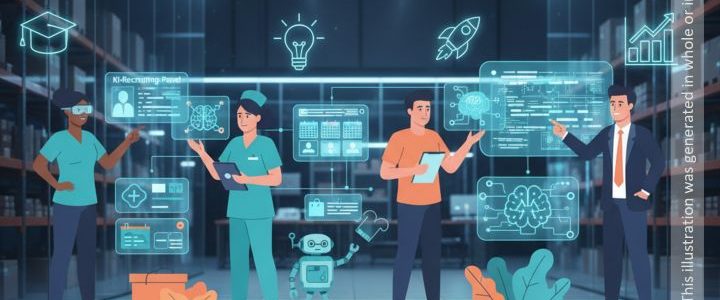
Artificial intelligence is no longer just for office roles. Today, it is transforming frontline sectors—from retail and logistics to manufacturing and healthcare.
Smarter hiring: AI recruiters now screen, interview, and shortlist candidates in days instead of weeks.
Dynamic scheduling: Algorithms forecast demand and fill shifts automatically to maximise efficiency.
AI-powered coaching: Digital agents provide real-time, multilingual training and support on the job.
This shift doesn’t just boost productivity—it empowers frontline employees with new digital skills and confidence to thrive in a tech-driven world.
At a time when leadership and adaptability are top global skills, entrepreneurial education provides the mindset needed to face complexity with creativity and resilience.
It’s not only about business—it’s about developing individuals who turn challenges into opportunities and lead with purpose.
Worldwide initiatives such as NFTE and RenovaBR prove how entrepreneurial learning helps cultivate capable, forward-thinking leaders who can drive sustainable transformation.
3. Why leaders must prioritise AI literacy
The key question today isn’t what AI can do—it’s what people can do with AI.
True readiness depends on embedding AI literacy across teams and organisations. According to Amit Sevak from ETS, leaders must grasp three truths:
Measurement matters: Defining and tracking AI literacy is essential for future readiness.
More than tech skills: Human qualities like ethics, curiosity, and critical thinking remain crucial to guide AI responsibly.
Delay amplifies risk: The pace of AI development means waiting only widens the skills gap.
AI literacy will define which organisations stay competitive in an increasingly intelligent world.
Smarter thinking through entrepreneurial mindset
Whether leveraging AI, education, or leadership, the message is clear: the future of work belongs to those who think smarter and act entrepreneurially. An entrepreneurial mindset gives anyone a true competitive advantage—driving innovation, resilience, and impact in a world of constant change.
IDEASCANNER enables businesses to unlock exactly that potential. With data-driven insights, organisations gain clarity on their business model and uncover new opportunities for innovation and growth.
How AI Models Shape Knowledge: The Most Cited Websites in the AI Age – What Every Business Should Know
A recent Semrush analysis reveals where large language models (LLMs) like ChatGPT source their knowledge: Reddit (40.1%), Wikipedia (26.3%), and YouTube (23.5%) are the top-cited domains. Over 40% of AI-generated answers rely primarily on user-generated content. But what does this mean for data quality, business decisions, and your own competitive strategy?
Key Facts and Risks
Highest citation shares: Reddit, Wikipedia, YouTube, Google, and Yelp lead the pack.
Geodata is predominantly sourced from Mapbox, OpenStreetMap, and Mapquest.
Community-driven platforms (e.g., Reddit) offer both opportunity and risk: misinformation, echo chambers, and limited domain expertise can shape or skew decisions.
Why it matters for business
The dominance of user-generated content shapes how AI models detect trends, assess opportunities, and flag risks – and this can impact your business model in real-time. Relying on AI-powered analysis means you must pay special attention to both the diversity and quality of sources.
your business model’s resilience to misinformation,
which trends AIs are likely to amplify or overlook,
and how to secure your competitiveness before misleading narratives take hold.
Strengthen your innovation potential
Contact us for your customized business model analysis. Book your first free online consultation and discover how IDEASCANNER’s AI can future-proof your business.
Follow IDEASCANNER for more actionable expert insights to think smarter with AI together.
The launch of Figure 03 marks a milestone in robotics: the new humanoid robot from Figure Robotics is now designed for Helix, the home, and the world of work at scale. This blog post explores the key innovations of Figure 03 and highlights why such breakthroughs are crucial for established business models — and how IDEASCANNER enables you to spot innovation potential early.
Figure 03: Revolution in Human-Machine Interaction
With a completely redesigned sensory suite, advanced hand system, and the integration of the Helix AI platform, Figure 03 surpasses current robotic systems by a wide margin. Its new vision architecture provides double the frame rate, a quarter of the latency, and a 60% wider field of view. Especially impressive: the tactile sensors in its fingertips can even detect the pressure of a single paperclip, enabling precise gripping and manipulation.
Innovation at Scale
Another breakthrough is its scalable manufacturing: Figure 03 was designed from the ground up for high-volume production, with a reinvented supply chain, streamlined assembly, and the dedicated BotQ production center. This enables manufacturing of up to 100,000 robots within four years, with falling unit costs and strict in-house quality control.
Everyday Usability & Safety
Figure 03 is equally practical for home use, featuring soft textiles, lighter weight, and enhanced pinch protection. Its advanced battery systems offer top-tier safety and wireless charging, while robust audio upgrades make communicating with the robot more intuitive than ever.
Implications for Business Models
Such innovations are more than tech milestones, they are game changers for entire industries. Automation, new value chains, and digital business models are emerging at unprecedented speed. To assess how robotics and AI-driven change will impact your business, you need the right analytical tools.
Your Next Step with IDEASCANNER
Discover the innovation potential of your business model with IDEASCANNER! Whether it’s AI, robotics, or new manufacturing processes, IDEASCANNER enables data-driven, benchmark-strong analysis of potential and blind spots. Start now, before the next technological leap changes your industry. Contact us for your customized business model analysis.
Book your first free online meeting with us to increase your company value with AI and let’s talk.
Yet, as the latest Digital Food Monitor shows, most companies still lack a strategic approach to AI and rarely put their business models to the test.
As an expert voice in this industry study, Melanie Stütz (CEO of IDEASCANNER) sums it up: “Companies who regularly stress-test their business models with AI tools are the ones who gain a real advantage for tomorrow.”
Why Critical Reflection Matters
Fast-changing consumer trends, efficiency pressures and regulations mean companies must constantly rethink their business model – especially as algorithms and data models become ever more influential.
AI can spotlight new potential, automate processes, and reveal opportunities and threats early.
Those who approach AI with curiosity and an open mind identify blind spots and innovation opportunities much sooner.
The Stress Test as Competitive Edge
Stress test, don’t stand still: Businesses that regularly challenge their models spot needed change before the market forces their hand.
IDEASCANNER delivers an objective, data-driven check – revealing your potential and enabling real strategic options.
Act now – with IDEASCANNER
Use the power of AI for strategic market intelligence! Book your initial business model analysis with IDEASCANNER and future-proof your enterprise for the next wave of innovation. In a fast-moving food sector, only those ready to question themselves stay competitive over the long term.
Contact us for your customized business model analysis. Book your first free online consultation and discover how IDEASCANNER can increase the value of your company with AI.
Follow IDEASCANNER for more actionable expert insights and let’s think smarter with AI together.